
Keeping a household budget: how to stick with it
Most household budgets don’t fail because of the maths but because of the habit. After three weeks receipts are missing, after three months the spreadsheet is forgotten. A few simple rules turn it into a routine that takes a few minutes a week and shows you where your money really goes.
Why household budgets usually fail
A household budget should answer one question: is there enough money, and what is it spent on? But many start with the ambition to record every cent immediately and in exactly the right subcategory. Nobody keeps that up for long.
- Too much detail: 30 categories turn every entry into a decision.
- Only looking back: if you only analyse at the end of the month, you can’t change anything anymore.
- No fixed time: “I’ll do it tonight” quickly becomes “I’ll never do it”.
- Typing in fixed costs every time: the same items over and over get annoying and are eventually left out.
Step by step to a household budget that lasts
- Enter your incomeSalary, child benefit, side job: everything that comes in regularly. If your income varies, use a cautious average.
- Record your fixed costs completely, onceRent, electricity, internet, phone, insurance, subscriptions, loans. Ideally with the bank statements of the last three months next to you. Don’t forget annual amounts; more on this in Plan for annual expenses.
- Five to eight categories for everyday lifeFor example groceries, mobility, leisure, health, clothing, other. Get more detailed later, when you notice something is missing.
- A fixed weekly slotFive minutes on Sunday evening: add the week’s receipts and card payments, tick off fixed costs that have been debited.
- A short review once a monthWhich category was over plan? Were there outliers? That takes ten minutes and is completely enough.
Calendar instead of spreadsheet: plan ahead
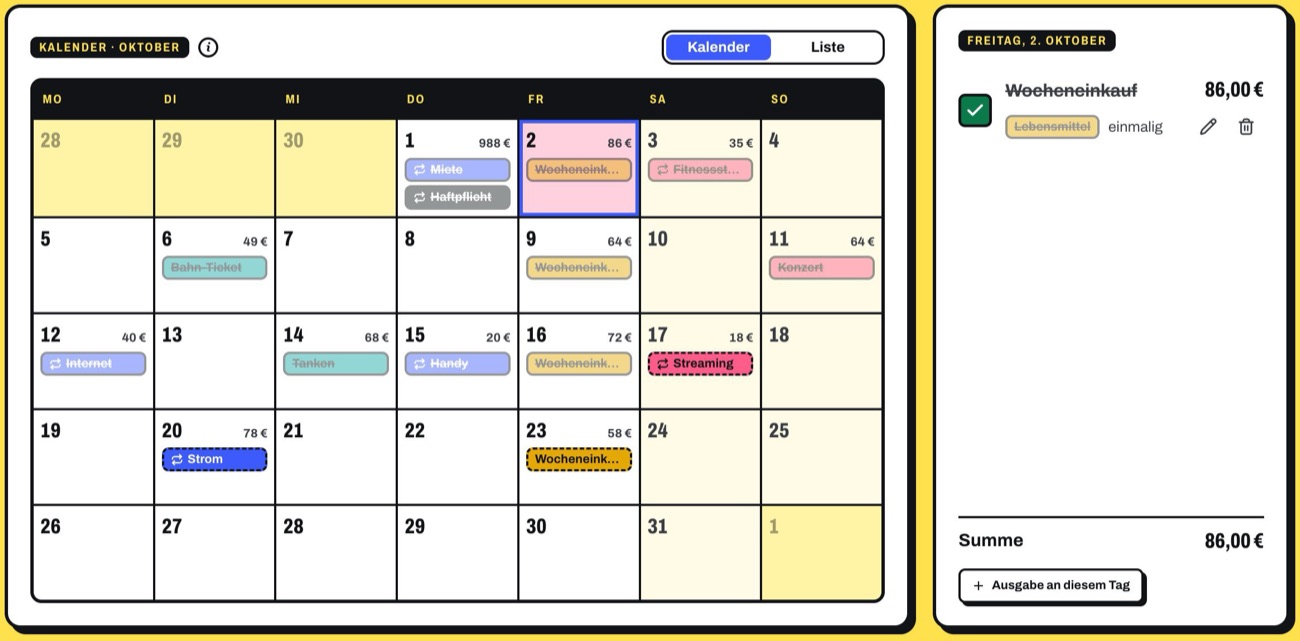
A spreadsheet shows what was. What’s still to come is more interesting. When every expense sits on its day in a calendar, on the 10th of a month you see that the car insurance goes out on the 15th and the rent on the 28th. This gives you an honest number: what’s really free until the end of the month.
In everyday life this number is more helpful than any analysis. It directly answers the question “Can I afford this right now?”. How to calculate it is explained in What’s really left at the end of the month?.
An example month
| Net income | €3,400.00 |
| Fixed costs (rent, electricity, internet, phone, insurance, subscriptions) | − €1,395.00 |
| Groceries | − €420.00 |
| Mobility | − €180.00 |
| Leisure | − €150.00 |
| Other | − €120.00 |
| Left over | €1,135.00 |
|---|
How it works in Ausgabentracker
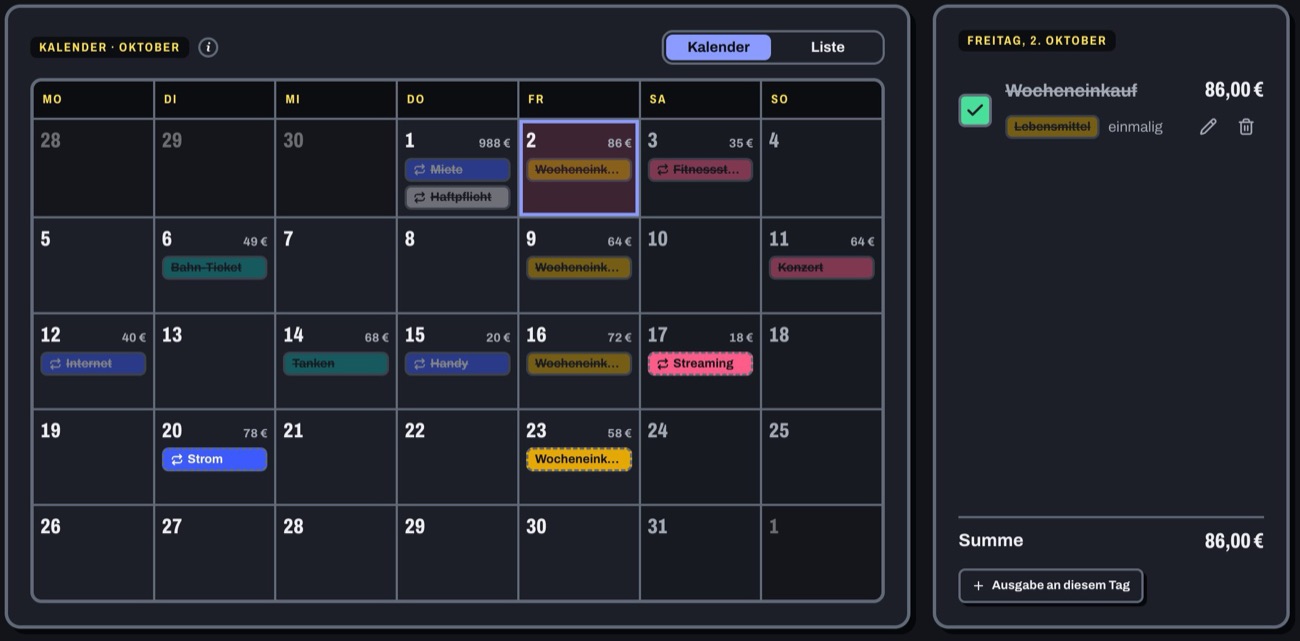
Ausgabentracker is a household budget in a calendar. You enter recurring expenses once, and they then sit on their day every month. You tick off what has been debited.
- Recurring expenses monthly, quarterly or annually
- Your own categories with colors, templates for frequent entries
- Overview: left this month, still open, paid
- On your phone like an app, with reminders before payments are due
Frequently asked questions
Do I have to keep every receipt? No. For card payments a look at your online banking is enough. For cash you can use a weekly lump sum.
What do I do with cash from the ATM? Either book the withdrawal as one expense in the matching category or book the individual purchases. What matters is that you don’t count it twice.
How long until it pays off? After the first complete month you see your fixed costs in black and white; after three months you recognise patterns.
App, spreadsheet or paper? The tool you actually use is the right one. Apps do the maths for you and remind you, spreadsheets are flexible, paper is the simplest. What matters is that recurring expenses don’t have to be entered again every time.
Does my partner have to take part? It helps a lot for shared expenses. If one of you starts alone, it’s enough to enter the shared costs as a block and see your own share.